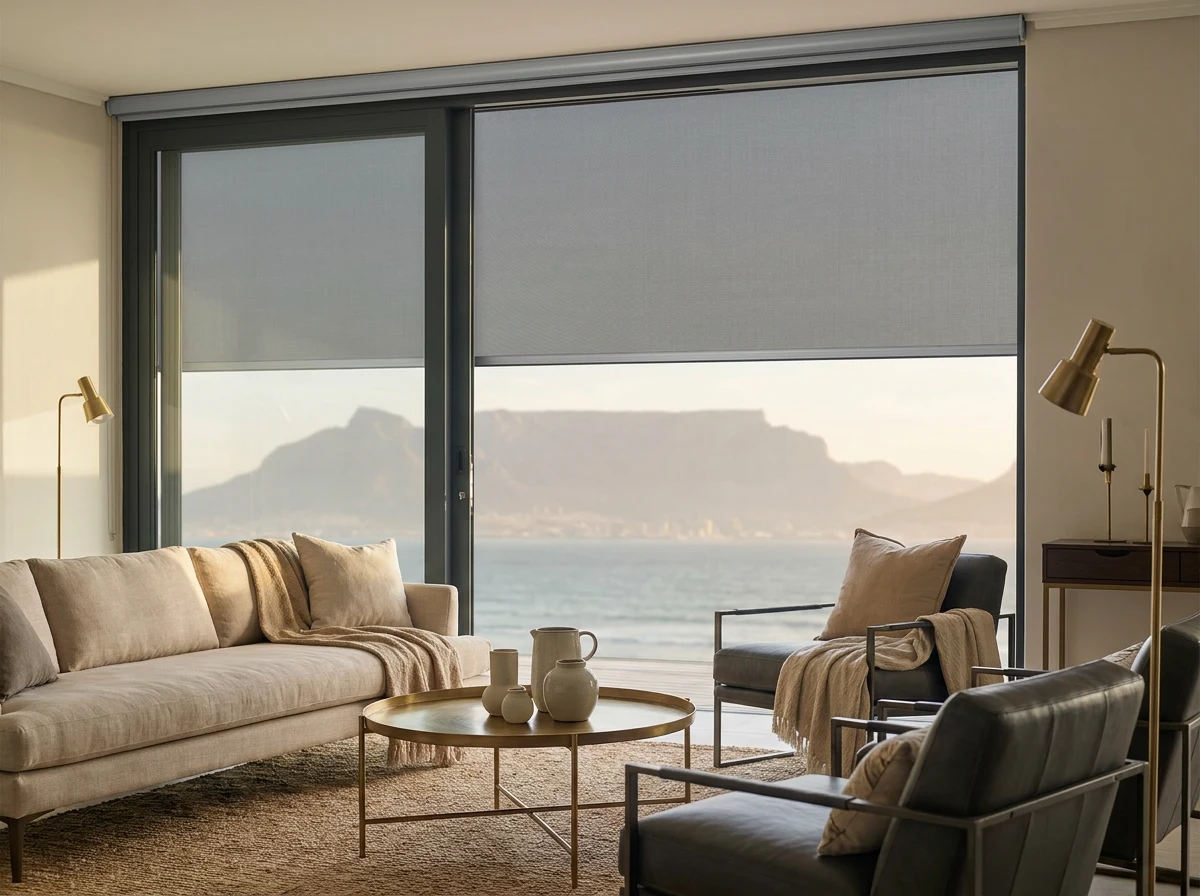
Sunscreen roller blind lowered halfway across the glass front of a Bloubergstrand lounge, Table Mountain standing across the bay behind it

Home / The Guide

The Second Sun

Free, sourced and written for one beach. Bloubergstrand does not have a sun problem so much as a sun-and-mirror problem — and the mirror is the reason most blinds bought here are bought in the wrong place.

Free · no obligation · nothing to fill in

Almost every shading article you will read was written for a house with land on all four sides. Bloubergstrand has open water on one, an old dune belt behind, and 15 km of nothing between the front door and central Cape Town.1 That changes where the light comes from, which changes what belongs on the glass. Everything below is either cited or worked out from the geometry, and the full list sits at the foot of the page.

One

The bay is a mirror

Stand on the beach at Bloubergstrand and the famous thing is behind the water, not in it: Table Mountain, across roughly ten kilometres of Table Bay, in the vantage point that put this village on more postcards than any other stretch of Cape coast.1 Robben Island sits about 6.9 km off the same shoreline, low and flat on the horizon.1 Nothing between your window and either of them breaks the light.

That is the first thing a measure has to take seriously. In an inland suburb the sun is a single object in the sky and a blind is a lid you put between it and the room. Here it is two objects: the sun itself, and a very large sheet of moving water lying almost flat in front of you that hands a great deal of that light straight back. On a clear afternoon a Blouberg lounge is lit twice — once from above, once from the bay — and the two need completely different answers.

The second thing is the building stock, because it decides what is physically possible. This is a suburb that filled out substantially through the 1970s and still carries that generation of low beach cottages with small punched windows, standing a few plots away from glass-fronted homes built to swallow the view whole.1 A recommendation that suits one is often wrong for the other, and the honest version of this guide says so as it goes.


Two

Where the sun actually goes

Bloubergstrand sits at about 33.80° south.1 From that latitude and the earth's 23.4° tilt, four numbers fall out — these are calculated, not quoted from a local weather station, and they hold for anywhere along this beach:

  • Midsummer noon: roughly 80° above the horizon. Near-vertical. A modest eave or balcony slab genuinely shades a window at this hour.
  • Midwinter noon: roughly 33°, due north. Low enough to walk straight in under that same eave and reach several metres into a room.
  • Midsummer sunset: about 28° south of due west. The sun goes down on the mountain side of the horizon — the same quarter your view window is pointed at.
  • Midwinter sunset: about 29° north of due west, and sunrise about 29° north of due east. The whole arc slides north for the winter.

Read that fourth line twice if your lounge faces the mountain. A wall facing south or south-west is described in every general-purpose shading article as the easy one, the cool one, the wall you can safely fill with glass. For about two months either side of the December solstice that is simply not true on this beach: the setting sun swings round to the south of west and comes down the exact axis of the view, low and unfiltered, for the last hour and a half of daylight.

The practical version: your best window is a winter window and a summer problem. It is comfortable from April to August and it is the hardest glass in the house from late November to late January — and that is precisely when the braai is lit and the house is full.

Three

Light that arrives from below

Here is the part most quotes miss. Water is a poor mirror when you look straight down into it and an excellent one when you look across it. As the sun drops toward the horizon its rays strike the sea at a shallower and shallower angle, and the proportion bounced off the surface instead of absorbed into it climbs steeply. By the last hour of a summer day, a wide band of Table Bay is throwing light back at the shoreline almost as brightly as the sun is delivering it.

The pale sand does its share too. A dry beach reflects a good deal more of the light landing on it than grass or tar ever would, and the reflection is diffuse — thrown everywhere, including upward.

"An overhang is a hat. It is useless against light coming off the floor."

The consequence is specific and it changes what you buy. Reflected glare arrives below the horizontal — it enters through the bottom half of the glass and lands on ceilings, on the tops of picture frames, on a television screen, on the pale wall opposite. Every device designed to intercept sun from above is beside the point against it: the pelmet, the eave, the balcony slab of the flat upstairs, and the roller blind you pull down from the top and stop halfway, which leaves the lower half of the window — the half doing the damage — wide open.

Three answers work, and one of them costs almost nothing:

  • Close the bottom, not the top. A cellular blind fitted bottom-up shades the lower band of glass and leaves the mountain visible above it. It is the cheapest fix on this list and, for a room whose only real complaint is the four-o'clock sheet of light off the water, often the right one.
  • Shade the whole opening in a fabric you can still see through. A sunscreen mesh around 3–5% openness cuts the brightness of the whole window uniformly, including the reflected part, while the bay stays legible through the weave.
  • Angle something outside the glass downward. This is what external venetian blinds do that no interior product can: tilt the slats down and they intercept light coming up off the water before it ever touches the pane.
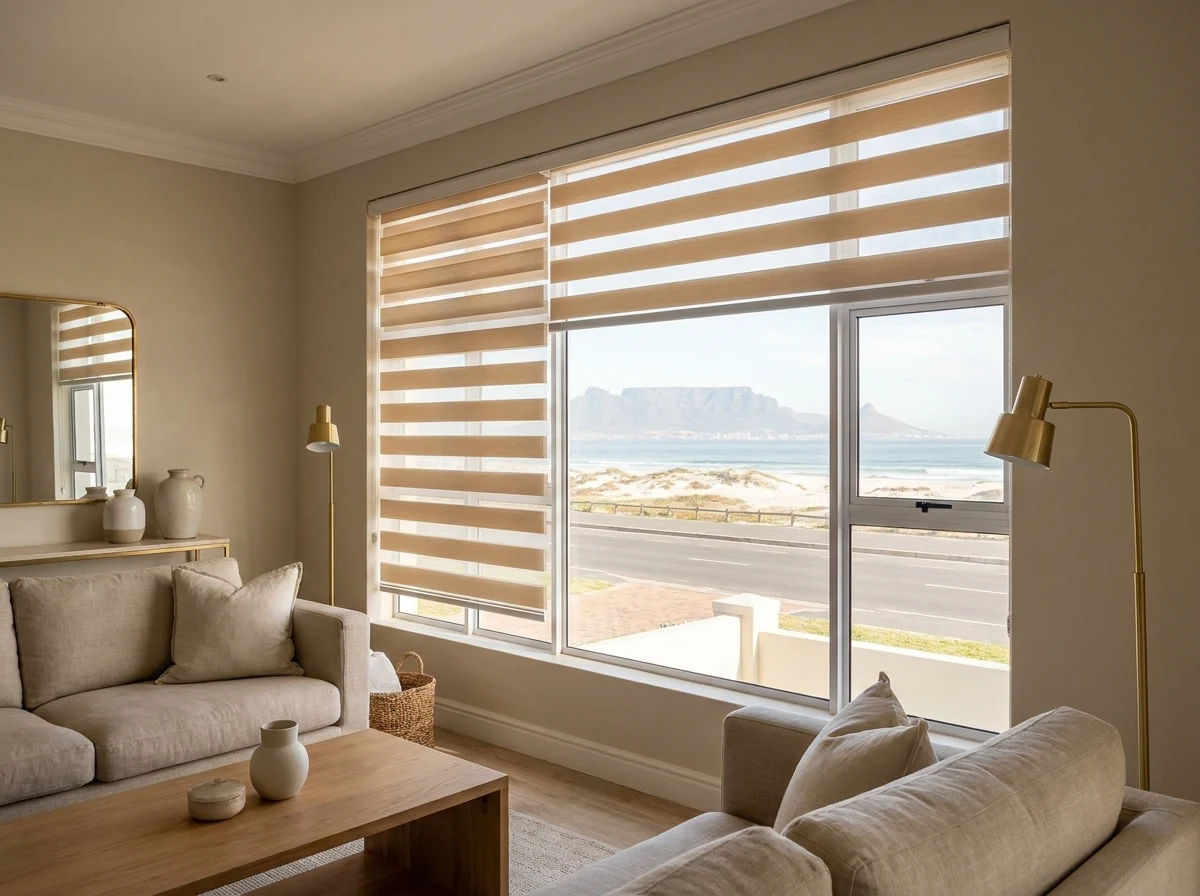
Day-night blind with alternating sheer and solid bands drawn over a Bloubergstrand lounge window looking onto the beach road
Banded day-night fabric lets you slide the solid stripes down over the bottom of the glass and leave the sheer ones at eye level — one of the simplest ways to answer glare that arrives from underneath.
Four

Start outside the glass

Once sunlight has crossed a pane it has already become heat in the room. An interior blind then absorbs that heat and re-radiates a fair share of it inward — it manages the glare beautifully and the temperature only partly. Anything mounted on the outside stops the energy before the glass warms at all, which is why on a west or south-west Blouberg elevation the external range is the honest first recommendation rather than the upsell at the end.

External venetians

The one that can aim

Wide aluminium slats outside the glass, tiltable through the day: closed against the low sun, angled down against light off the bay, open flat when you want the view back. No other product on this coast can be pointed at the problem.

Roller shutters

The one that seals

Rigid interlocking slats running down a fixed guide rail either side, so there is no loose edge for wind to lift. The most robust of the three in a blow, and the one that also gives a holiday house real dark and real privacy. Shading, not security — we say that plainly.

Zip screens

The one that makes a room

Mesh with its edges zipped captive into aluminium side channels, so it holds tension instead of flapping. This is what turns an unusable windy patio into somewhere you actually sit, with the bay still visible through the weave.

Folding-arm awnings

The one that disappears

Right for a sheltered courtyard or a deck with something upwind of it. On a fully open Blouberg stand it is the most exposed of the four, because an extended arm has nothing holding its outer edge down.

Being honest about wind ratings

Exterior shading comes with a wind class printed on it, and it is worth knowing what that number is actually claiming. The European product standard for external blinds and awnings, EN 13561, sorts them into wind-resistance classes 0 to 3 — and class 3, the top of the scale, corresponds to roughly a fresh breeze, not a gale.4 That is not a criticism of the products; it is what a fabric surface in moving air can be expected to do.

Now put that next to the wind here. Table Bay’s summer wind — the south-easter Capetonians named the Cape Doctor — owns this coastline from spring into early autumn, and gusts of around 160 km/h have been recorded over the bay itself.3 The reliable summer wind is exactly why Blouberg is a world-class kitesurfing beach, and it is the same wind that will find the loose edge of an awning.1

So the honest specification is this: the wind class tells you the conditions a product is designed to stay out in. Above that, it has to come in — and on a beach where the wind builds through the afternoon while everyone is out, that means an anemometer wired to the motor that retracts it for you. We fit wind-sensor motorisation on exterior products as standard here rather than as an option, and we would rather quote a roller shutter or a zip screen in a channel on an exposed stand than an awning that will spend the summer being wound in.

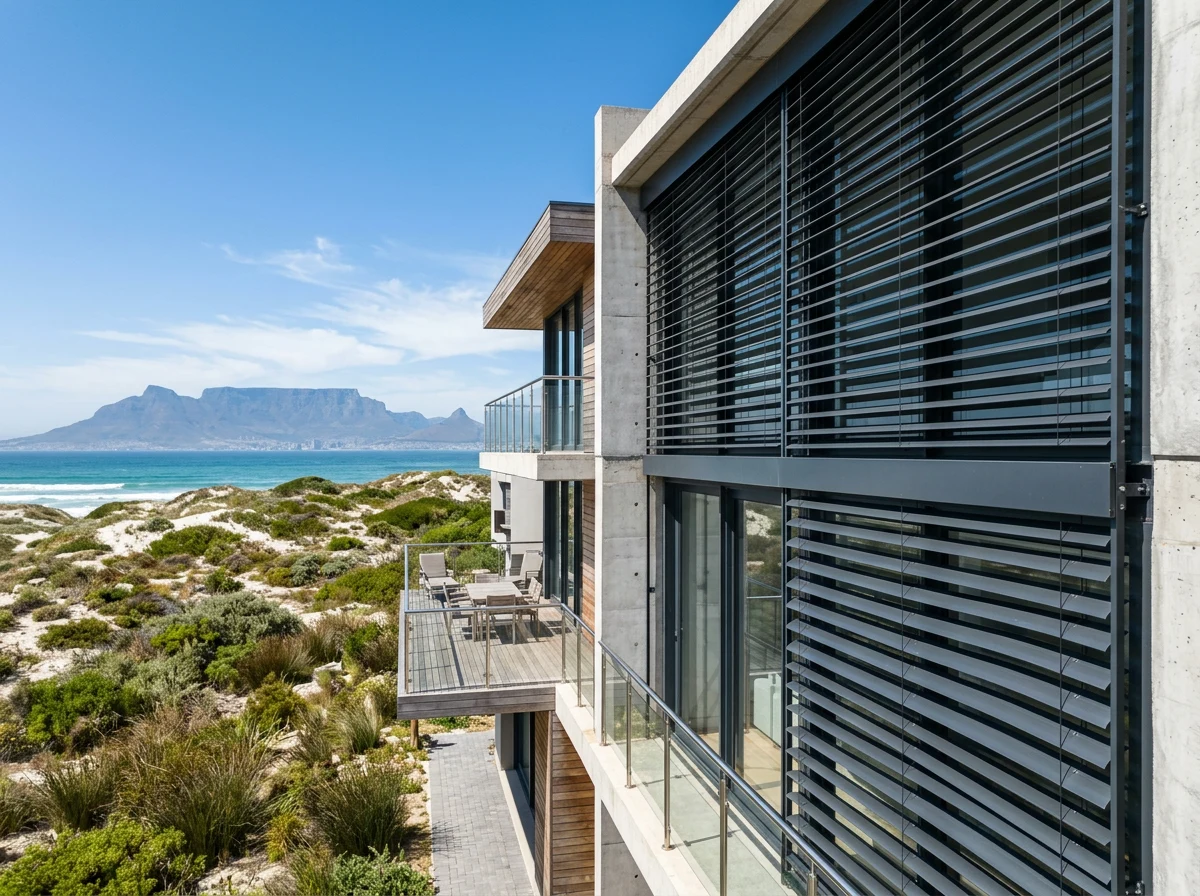
External aluminium venetian blinds mounted on the facade of a modern Bloubergstrand beach house above the dune line
External venetians on a Blouberg facade. The slats are the only part of the shading conversation that can be aimed downward at light coming off the water.
Five

Then inside it, wall by wall

Exterior products answer heat and the worst of the glare. Everything else — privacy after dark, sleep, a screen you can read, a kitchen that gets scrubbed — is still an interior job. Take a compass round the house before deciding anything; plenty of homes on the upper streets here are twisted toward the view rather than square to the road.

The view wall (south to south-west, across the water)

Sunscreen mesh, low openness, matched across the whole elevation so a row of windows reads as one decision. Where the room also has to go properly dark, one bracket can carry two fabrics — mesh in front, blockout behind — which is neater than hanging two separate blinds and cheaper than regretting the first one. Be aware of the honest limit of any mesh: it gives daytime privacy only. After sunset, with the lamps on, the effect reverses and you are the lit side of the glass — a real consideration on a house with a public beach path below it.

The north wall (the sun wall, every day of the year)

North glass takes the high summer sun and the low winter one, and the mistake is over-correcting. A heavy blockout throws away free June warmth to solve a January problem. Something adjustable belongs here — a tiltable venetian, a sunscreen you can set at any height, or an external venetian if the heat is genuinely the complaint.

Bedrooms

Almost no bedroom complaint is really about the fabric; every blockout fabric is opaque. It is about light leaking around the edges, and a shallow 1970s cottage reveal has very little room to hide that. Inside-fit looks tidiest and leaves a hairline down each side; face-fit over the opening is significantly darker and covers the reveal; inside-fit with side channels gets you both at the cost of one more component. Say which of the three you actually want and the quote follows from it.

Kitchens, bathrooms and anything that gets wiped

Aluminium venetians. They take steam, splashes and a cloth in a way fabric does not, and the tilt is useful over a sink where you want light without the person at the window opposite.

Stairwell and double-volume glass

The gable and clerestory glazing common in the newer builds around here is usually made to order for the actual angle rather than bought as a rectangle — tensioned shaped or skylight systems, which cost more and take longer precisely because they are cut to your pitch. Worth measuring properly rather than guessing from the ground.

Wide sliding and stacking doors

Panel or vertical systems stack right back and clear the opening, which matters on a door you actually walk through twenty times a day. A single roller across four metres of unbroken glass is a chain you will come to resent; we would split it or motorise it and say so at the measure.
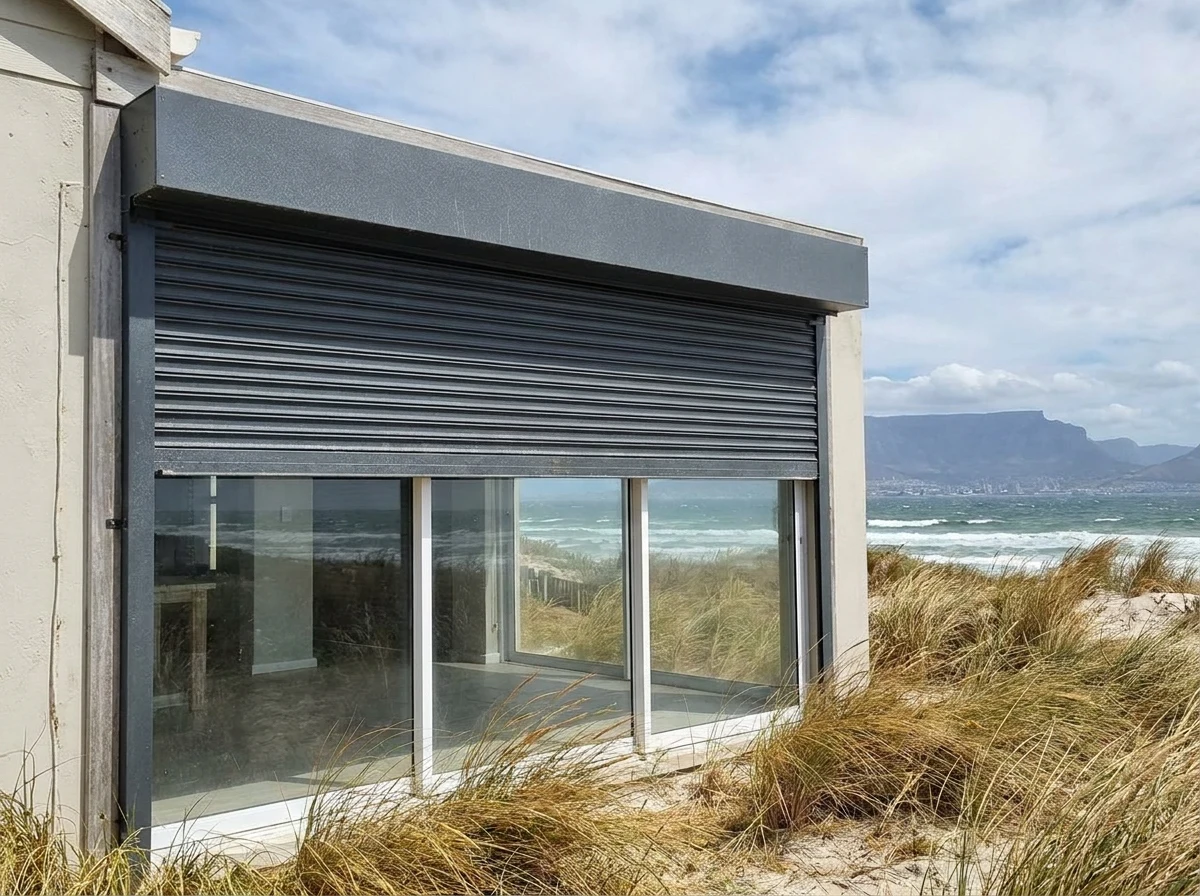
Aluminium roller shutter lowered over the patio door of a Bloubergstrand beach house, dune grass growing in the foreground
A roller shutter over a patio door — the slats run in a fixed guide either side, which is why this is the exterior product we reach for first on a fully exposed stand.
Six

Salt and sand, told straight

Two things reach hardware on this beach and they are worse together than apart. Airborne salt is hygroscopic — it pulls moisture out of the air and holds a damp, conductive film against metal, which is what drives corrosion on an untreated fixing. Wind-blown sand off the dune belt behind the beachfront is abrasive, and it works by scratching through the protective coating that was keeping the salt out in the first place.

What follows from that is not complicated, and it is not a maintenance-free promise:

  • Marine-grade powder-coated aluminium and stainless fixings on anything mounted outside — not because it is a nicer finish, but because the coating is the whole defence.
  • Sealed cassettes rather than open tubes and tracks, so grit has fewer places to sit.
  • A hose over the exterior hardware two or three times a year, and more often in the front row. Five minutes of work, and the highest-value thing an owner here ever does.
  • Interior blinds are fine, but a window left open on a windy day still lets fine sand settle in a headbox. Aluminium wipes; some fabrics do not love it.

Anyone who tells you a product on this coastline needs nothing is selling, not specifying.

The short version
  • Half your glare comes off the water and the sand, from below the window
  • So shading the top half of a window is often the wrong half
  • Midsummer sun sets 28° south of west — down the view axis, not away from it
  • Exterior first for heat; interior for privacy, sleep and screens
  • A wind sensor matters more than the number on the datasheet
Sectional title? Anything fixed to the outside of the building is normally the body corporate's call, not yours. We check that before quoting, not after.
Seven

Five things a photograph will not tell you

A map and a compass got you this far. They cannot get you further, because the next five live in the building itself, and any one of them can change the answer:

  1. Reveal depth at three points per opening. Older cottage frames here are rarely square, and a difference of fifteen millimetres decides whether a headbox sits inside the joinery or proud of it.
  2. What the wall is actually made of. Brick and cavity, a rebuilt stud wall, or a lightweight infill panel between structural columns on a newer build. The substrate decides the bracket, and whether an exterior system can be carried on that wall at all.
  3. The true bearing of each room. Not the street's bearing. On the upper streets the difference is routinely twenty or thirty degrees, and everything in sections two and three hangs on getting it right.
  4. How exposed your specific stand is. A courtyard with a neighbour upwind and an open first-row deck behave nothing alike in a south-easter, and that single fact decides awning versus zip screen.
  5. Where the power is, and who has to approve what. Whether a plug is within reach of a tube motor, whether a battery tube can be recharged without a ladder, and whether the scheme rules have anything to say about a bracket visible from the street.

That is why the visit costs nothing. Guessing at any one of them and then manufacturing to the guess is how a window schedule goes wrong, and remaking a blind is a great deal more expensive than driving out to look.

Bring this guide to your own windows

A consultant comes to you with fabric and slat samples, measures every opening, and leaves you with a written, itemised, per-window quote. No charge, no obligation either way.

Book a free in-home measure
Get in touch

Tell us which wall is the problem

Say which rooms and which direction the worst glass faces, and one of our expert consultants will contact you shortly to arrange your free in-home measure.

  • No obligation, no call-centre — a consultant calls you directly
  • Fabric samples brought to the measure, not just a screen swatch
  • Written, itemised quote before anything is ordered

Your details are used only to arrange your consultation call-back and are never shared beyond that, in line with our Privacy Policy (POPIA).

Working out

Where each fact came from

Every geographic and climate claim above traces to one of these. Where a figure was calculated rather than quoted, it says so.

  1. Bloubergstrand, Wikipedia — coordinates 33°47′50″S 18°27′43″E; 15 km due north of central Cape Town; the classic view of Table Mountain across the bay; Robben Island 6.9 km west of the coast; substantial 1970s development; cold Benguela-current water and world-class kitesurfing conditions. en.wikipedia.org/wiki/Bloubergstrand
  2. Solar geometry — calculated, not cited. The noon altitudes (≈80° at the December solstice, ≈33° at the June solstice) and the sunset azimuths (≈28° south of west in midsummer, ≈29° north of west in midwinter) are worked out from Bloubergstrand's latitude of 33.80° S and the earth's 23.4° axial tilt. They are standard geometry for this line of latitude rather than readings from a local station, and we would rather label them that way than dress them up.
  3. The Cape Doctor — the south-easterly, blowing mainly October to March and most persistently in November and December, with speeds up to around 160 km/h measured about Table Bay. capetownmagazine.com/cape-doctor
  4. EN 13561, the European standard for external blinds and awnings, which classifies wind resistance in classes 0 to 3. We cite it for what a wind class is and how modest the top of that scale is, not as a South African regulation.
  5. Reflection off water and sand — that the share of light reflected from a water surface climbs sharply as the sun approaches the horizon, and that dry pale sand is a strong diffuse reflector, is standard optics and standard albedo data rather than a local measurement. We have described the effect and left the numbers out, because we have not measured them on this beach.

What we would fit, and why, is our own judgement — given free, with nothing attached to it. Anything to do with planning permission or scheme rules is decided by your trustees and by the City of Cape Town, not by us.