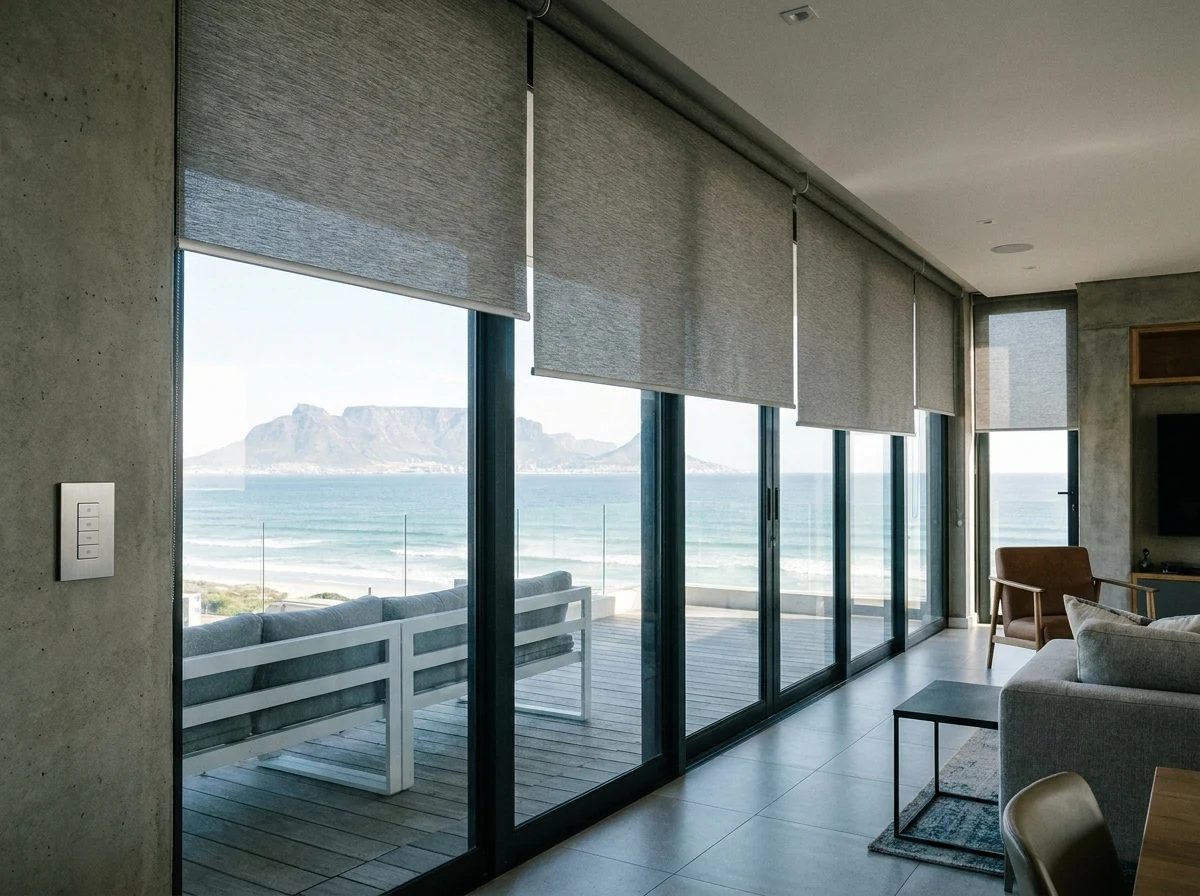
Why motorisation is the default here, not the upsell
Elsewhere, motorisation is mostly a convenience upgrade. On Bloubergstrand's exposed exterior products — zip screens, roller shutters, external venetians, folding-arm awnings — a wind sensor that auto-retracts before a gust hits is close to essential, given how directly this stretch of coast catches the south-easter. We spec it as standard on exterior products, not as an optional extra to talk you into.
Battery or wired, depending on the build
Rechargeable battery motors are the retrofit default for the 1970s-era cottages around Stadler Road — no wiring, no chasing walls, a straightforward fit into an existing frame. Wired motors suit the newer glass-box builds around Big Bay, where the electrical plan can account for them from the start, particularly on wide or heavy exterior systems.
Control that matches how you actually use the house
A single remote for a whole glass wall, an app for when you're not home and the wind's picked up, schedules for bedroom blinds that open with sunrise, and the wind sensor doing the safety-critical work in the background regardless of who's home. No dangling chains anywhere is also, straightforwardly, the most child-safe operation there is.
What motorisation costs
There is no single figure for motorisation, because the price belongs to the product being driven rather than to the motor on its own. Across the range that we fit here, motorised shading runs from about R2,500 to R7,500 per square metre installed: a motorised interior roller at R2,500 to R3,800, a motorised zip screen at R4,000 to R6,000, and a motorised roller shutter at R5,000 to R7,000.
A minimum applies under about a square metre whatever moves the blind. Dropping a battery motor into an existing frame and wiring one into a new build are also two quite different pieces of work. Which of those your house wants, and what each opening costs, is worked out on the free measure and written up before anything is ordered.
- Battery (retrofit) or wired (new build) tubular motors
- Wind-sensor auto-retract standard on exterior products
- Remote, app, wall switch and schedule control
- No cords or chains — the most child-safe operation there is
Exterior screen or shutter that needs a wind sensor?
We measure for free and put a price against each window in writing. No obligation.